When Clickbait Meets Climate
Discussions around landfill methane emissions tend to follow a familiar cycle: periodic headlines resurface long-standing claims, usually without the full scientific context needed to really understand the issue. They often paint a picture of landfills running amok, leaking invisible plumes of methane into the atmosphere, and a lack of ability to effectively address climate change. These stories often cite alarming claims: EPA formulas are flawed, satellites see methane that models don’t capture, and emissions are FAR worse than we thought!
Let’s be clear: Methane is a real and potent greenhouse gas, landfills do emit methane, and methane management at landfills is not without its share of challenges. However, the narrative that landfills represent an outsized or neglected piece of the climate problem can be misleading and lack important scientific context.
Perspective Matters
When it comes to greenhouse gas (GHG) emissions, scale and proportion are essential to understanding where action is most needed. Of all greenhouse gases, carbon dioxide contributes nearly 80%,and methane is the 2nd most dominant at ~11% (Figure 1).
Of the 11% of GHGs that consist of methane, oil/gas and agriculture collectively account for 58%, while landfills are the third largest source, accounting for about 14.4%, according to the U.S. EPA’s Inventory of U.S. Greenhouse Gas Emissions and Sinks (Figure 2). If methane emissions from landfills are considered relative to the total amount of GHGs produced (e.g. CO2, methane, etc.), landfills accounted for 1.9% of the total U.S. greenhouse gas emissions in 2022 (119.6 mmt CO₂-equivalent) out of the nation’s total 6,343 mmt CO₂-e (EPA, 2024).
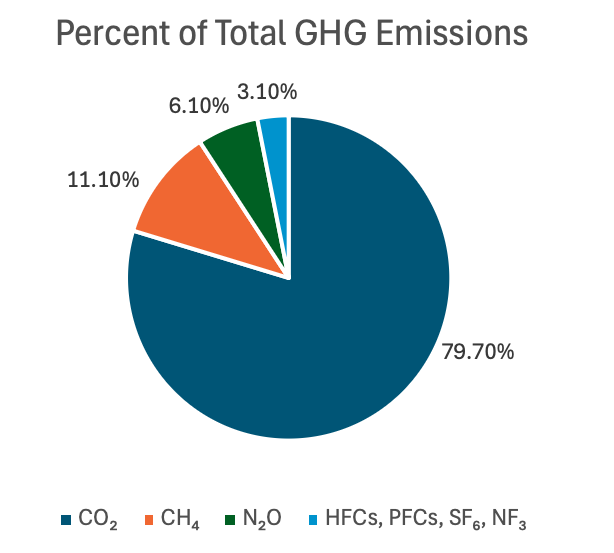
Figure 1. Composition of U.S. greenhouse gas emissions by gas type (EPA, 2022)
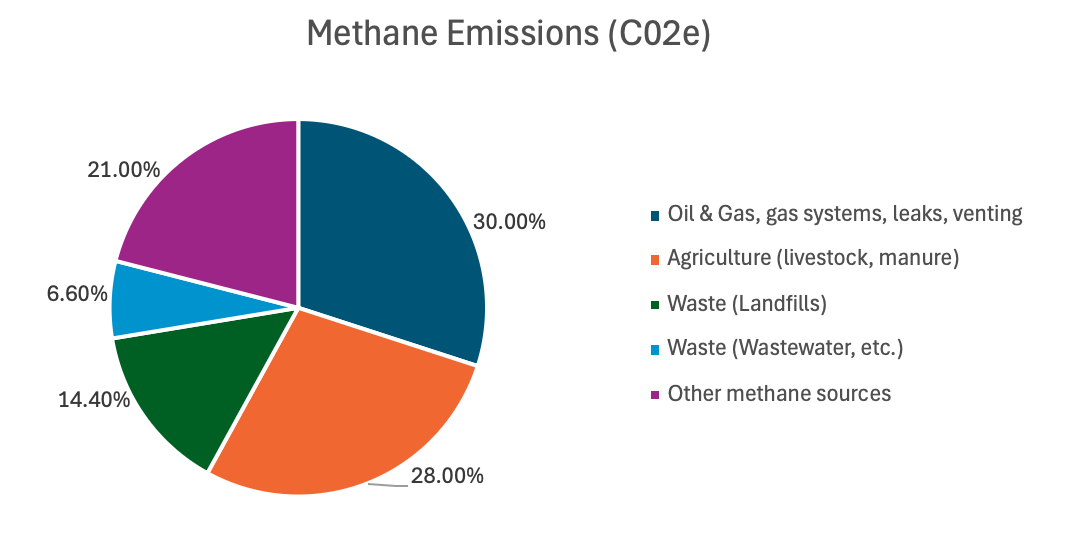
Figure 2: Methane Emissions (CO₂e) by Source, United States (EPA, 2024)
In context, this is a relatively small contribution to overall GHG emissions. In other words, even if landfill methane emissions were entirely eliminated, total U.S. greenhouse gas emissions would fall by less than two percent. That underscores the need to situate landfill emissions within a broader climate strategy that prioritizes the largest GHG sources — transportation (26%), energy (25%), and industry (23%) — while still capturing meaningful gains from the waste sector’s progress.
That’s why narrowing the climate conversation to landfill methane, without situating it in context, can lead to disproportionate public and policy attention. Highlighting a single source out of scale can make it appear to be the problem when in reality, it’s one component of a far more complex system.
When discussing landfill methane, it’s important to distinguish between two categories of landfill gas: collected gas and uncollected, or fugitive, emissions. The methane reported as emissions representsthe fugitive portion – the gas that escapes capture. Landfills are complex systems, and because of this, accurately measuring those fugitive emissions can be challenging. This is why significant efforts have been ongoing to evaluate and improve technologies capable of detecting and quantifying them.
Most municipal solid waste landfills already deploy gas collection and control systems (GCCS) designed to capture methane and either flare it (which destroys over 98% of the methane and converts it to less potent CO₂) or convert it to renewable natural gas (RNG) used for electricity, heating, and transportation fuels. According to EPA LMOP data, around 540 landfill gas-to-energy (LFGTE) projects are operating across the U.S., and a large portion of the waste disposed of annually, roughly 70%, is placed in landfills with active methane capture and beneficial use systems.
Some levels of fugitive emissions occur intrinsically simply as a function of typical waste management operations and efficiencies associated with them, which are the focus of ongoing monitoring and technological improvement efforts across the industry.
Accurate Measurement Matters
The recent claims about methane plumes and undercounted emissions often hinge on new and emerging measurement technologies that are still being tested and evaluated. Therefore, the results of these studies are also not fully vetted and benchmarked for accuracy, which in some cases can result in premature conclusions being drawn.
To address these limitations, EREF spearheaded a groundbreaking effort to better evaluate the accuracy and effectiveness of these technologies. The strategy involves releasing known amounts of methane (called a controlled release) and having technology providers attempt to measure it to evaluate accuracy. The study is conducted blindly, meaning that technology providers do not know what the rate of release is, and releases were performed under a variety of conditions and rates. This study allowed for field-testing 14 methane detection technologies under real landfill conditions across multiple years and included satellites, aircraft such as planes, helicopters and drones, ground-based methods (e.g. vehicle mounted, walking and stationary continuous sensors). Our findings revealed data that’s rarely reflected in media narratives: current measurement methods carry significant uncertainty. Depending on the technology, error rates ranged from -100% to +200% for non-continuous systems, and up to +3,600% for continuous methods. Meteorological conditions like wind, humidity, and temperature further complicate the picture. Further, non-continuous technologies provide only snapshots in time rather than a continuous picture, which further increases uncertainty.
These findings have real implications in how landfill methane emissions are viewed, interpreted, and managed by entities from regulators to NGOs to facility owners. By understanding the strengths and limitations of these tools, landfill operators can fine-tune gas collection systems, rapidly find and fix points of emissions, improve operational performance, and more accurately assess their climate impact. Technology vendors, informed by EREF’s data, are refining their equipment to deliver more reliable and actionable results. This is how real progress is made, not through headlines, but through science.
Addressing Climate Change with Practical Science
From RNG projects to improved cover systems, enhanced gas collection designs, and better measurement strategies, science is advancing a greater understanding that leads to solutions that reduce methane emissions today while supporting broader circularity and energy transition goals. In many cases, social media and advocacy rhetoric create noise that clouds perspective and results coming from sound science.